
Publicaciones 2024 —

Un siglo de planificación urbano-regional en Chile
Catalina Marshall
Tapa blanda
12,5 x 18 cm | 212 pp.
Español
ISBN: 978-956-6204-23-7
Serie Doctorado vol. 3
Diciembre 2024
Aunque hemos asumido su independencia, en la historia de Chile, ha habido breves encuentros entre los procesos de planificación urbano-regional y de descentralización administrativa. Instituciones, reformas, e incluso los cambios en la estructura y naturaleza de los gobiernos, han sido actores relevantes del relato doble que ha configurado la organización político-territorial del país. Este libro analiza el desarrollo de estos procesos entre 1925 y 2014, poniendo especial énfasis en cómo se han —o no se han— relacionado. Desde una mirada histórica y legislativa, hitos como la Ley Orgánica Constitucional de Municipalidades y la Ley Orgánica Constitucional de Gobierno y Administración Regional —junto a otros instrumentos—, muestran cómo la autonomía de los gobiernos locales es impulsada y coartada por la administración central, dibujando la trama compleja y cambiante que dio forma al Chile actual —y que da señales sobre su futuro—.
Catalina Marshall es arquitecta por la Pontificia Universidad Católica de Chile y magíster en Planificación Regional por Cornell University. Realizó su investigación posdoctoral en el Centro de Desarrollo Urbano Sustentable (CEDEUS). Se ha desempeñado como docente en el Instituto de Estudios Urbanos y Territoriales UC (IEUT). Actualmente, es investigadora del Centro CIUDHAD de la Universidad Andrés Bello (UNAB) y académica del Campus Creativo (UNAB) y de la Facultad de Arquitectura, Diseño y Estudios Urbanos de la Pontificia Universidad Católica de Chile. Su trabajo ha sido publicado en artículos científicos y en capítulos de libros, tanto en solitario como en colaboraciones.
Ver más →

130/30. Títulos, tesis, obras. Escuela de Arquitectura, Pontificia Universidad Católica de Chile
Paula Orta, Elvira Pérez, Rayna Razmilic, Wren Strabucchi (eds.)
Tapa blanda
17 x 24 cm | 240 pp.
Español
ISBN: 978-956-6204-24-4
Diciembre 2024
130/30 celebra los ciento treinta años de existencia de la Escuela de Arquitectura UC, reflejando, a través de una selección de proyectos de título y tesis, la transformación de la disciplina y su enseñanza desde 1894 —año en que se originó este proyecto educativo— hasta 2024 —año de esta publicación—. El volumen se concentra en la producción académica de las últimas tres décadas, dando continuidad a esfuerzos anteriores como el libro Cien años de arquitectura en la Universidad Católica (Ediciones ARQ, 1994) e incorporando los proyectos de título de destacados arquitectos y arquitectas UC que han recibido premios por su trayectoria en distintos ámbitos a nivel nacional e internacional.
Así, esta edición no sólo celebra un hito al recoger parte de la historia de un espacio de enseñanza, sino que además ofrece pistas para reflexionar sobre el pasado, el presente y el futuro de la disciplina, la construcción del conocimiento y el rol de la arquitectura en la sociedad. Un viaje fragmentario que atraviesa la memoria, los archivos y parte del cúmulo de ideas e imágenes creados por una comunidad.
Ver más →

ARQ 118 | Colectividad + Nuevos Medios / Collectivity + New Media
Libre acceso / Open Access
Stephannie Fell (ed.); varios autores
Tapa blanda
20.6 x 27 cm | 154 pp.
Español + Inglés
ISSN: 0716-0852 (impreso) / 0717-6996 (en línea)
Diciembre 2024
Conocemos el guion: la tecnología cambia, la arquitectura reacciona. Pero si la historia de los medios nos enseña algo, es que la novedad rara vez significa ruptura. Este número de ARQ explora cómo los medios contemporáneos —plataformas digitales, curaduría algorítmica, el incesante flujo de imágenes— moldean la práctica arquitectónica, no reemplazando los sistemas antiguos, sino traslapándose con ellos. Desde torres de radio hasta bucles de TikTok, desde concursos algorítmicos hasta centros de datos que reempaquetan la memoria, las colaboraciones exploran cómo los medios median con la arquitectura hoy.
Comprar
Comprar (internac.)
Leer en ARQ+
⤓ PDF (SciELO)
Tapa blanda
20.6 x 27 cm | 154 pp.
Español + Inglés
ISSN: 0716-0852 (impreso) / 0717-6996 (en línea)
Diciembre 2024
Conocemos el guion: la tecnología cambia, la arquitectura reacciona. Pero si la historia de los medios nos enseña algo, es que la novedad rara vez significa ruptura. Este número de ARQ explora cómo los medios contemporáneos —plataformas digitales, curaduría algorítmica, el incesante flujo de imágenes— moldean la práctica arquitectónica, no reemplazando los sistemas antiguos, sino traslapándose con ellos. Desde torres de radio hasta bucles de TikTok, desde concursos algorítmicos hasta centros de datos que reempaquetan la memoria, las colaboraciones exploran cómo los medios median con la arquitectura hoy.
Contenidos
Entre cámaras de eco y esfuerzos colectivos — Stephannie Fell
Escuchando los edificios — Ines Weizman
OFFICE 176. Edificio de radio y televisión suiza (RTS). Lausana, Suiza, 2014-2025 — OFFICE Kersten Geers David Van Severen
El cementerio y la memoria colectiva digital — Stefania Rasile
Tiempo de juego. Una criatura para armar y desarmar, Milán, Italia, 2020 — Giancarlo Mazzanti
El concurso de arquitectura en tiempos de IA, ¿emulación o revolución colectiva? — Asunción Díaz-García, María-Elia Gutiérrez-Mozo, José Parra-Martínez
Print Ready Drawings. Los Ángeles, USA, 2024 — Sarah Hearne, Julie Riley, Jenny Leavitt, Christina Huang, Current Interests
Brotes de una expectativa: La arquitectura del paisaje en la Pontificia Universidad Católica de Chile, 1976-1989 — Alejandra Bosch, Gabriela Castillo
HouseEurope! La iniciativa de los ciudadanos europeos - poder a la renovación. Europa, 2012 al presente — HouseEurope! b+ s+
Descentralización, saturación y atomización: estado del ecosistema digital arquitectónico — Nicolás Valencia
Privacidad y pubblicità — Davide Tommaso Ferrando
Ver más →
Entre cámaras de eco y esfuerzos colectivos — Stephannie Fell
Escuchando los edificios — Ines Weizman
OFFICE 176. Edificio de radio y televisión suiza (RTS). Lausana, Suiza, 2014-2025 — OFFICE Kersten Geers David Van Severen
El cementerio y la memoria colectiva digital — Stefania Rasile
Tiempo de juego. Una criatura para armar y desarmar, Milán, Italia, 2020 — Giancarlo Mazzanti
El concurso de arquitectura en tiempos de IA, ¿emulación o revolución colectiva? — Asunción Díaz-García, María-Elia Gutiérrez-Mozo, José Parra-Martínez
Print Ready Drawings. Los Ángeles, USA, 2024 — Sarah Hearne, Julie Riley, Jenny Leavitt, Christina Huang, Current Interests
Brotes de una expectativa: La arquitectura del paisaje en la Pontificia Universidad Católica de Chile, 1976-1989 — Alejandra Bosch, Gabriela Castillo
HouseEurope! La iniciativa de los ciudadanos europeos - poder a la renovación. Europa, 2012 al presente — HouseEurope! b+ s+
Descentralización, saturación y atomización: estado del ecosistema digital arquitectónico — Nicolás Valencia
Privacidad y pubblicità — Davide Tommaso Ferrando
Stephannie Fell (ed.); several authors
Softcover
20.6 x 27 cm | 154 pp.
English + Spanish
ISSN: 0716-0852 (print) / 0717-6996 (online)
December 2024
We know the script: technology changes, architecture reacts. But if the history of media teaches us anything, it’s that novelty rarely means rupture. This issue of ARQ explores how contemporary media—digital platforms, algorithmic curation, the ceaseless churn of images—shapes architectural practice, not by replacing old systems but by layering over them. From radio towers to TikTok loops, from algorithmic competitions to data centers repackaging memory, contributors dissect how media mediates architecture today.
Buy (Chile)
Buy (international)
Read on ARQ+
⤓ PDF (SciELO)
Softcover
20.6 x 27 cm | 154 pp.
English + Spanish
ISSN: 0716-0852 (print) / 0717-6996 (online)
December 2024
We know the script: technology changes, architecture reacts. But if the history of media teaches us anything, it’s that novelty rarely means rupture. This issue of ARQ explores how contemporary media—digital platforms, algorithmic curation, the ceaseless churn of images—shapes architectural practice, not by replacing old systems but by layering over them. From radio towers to TikTok loops, from algorithmic competitions to data centers repackaging memory, contributors dissect how media mediates architecture today.
Contents
Between Echo Chambers and Collective Efforts — Stephannie Fell
Listening to Buildings — Ines Weizman
OFFICE 176. Radio & Television building (RTS). Lausanne, Swiss, 2014-2025 — OFFICE Kersten Geers David Van Severen
The Cemetery and Digital Collective Memory — Stefania Rasile
Playtime. A creature to assemble and disassemble. Milano, Italy, 2020 — Giancarlo Mazzanti
The Architecture Competition in the Age of AI: Emulation or Collective Revolution? — Asunción Díaz-García, María-Elia Gutiérrez-Mozo, José Parra-Martínez
Print Ready Drawings. Los Ángeles, USA, 2024 — Sarah Hearne, Julie Riley, Jenny Leavitt, Christina Huang, Current Interests
Sprouts of Expectation: Landscape Architecture at the Pontificia Universidad Católica de Chile, 1976-1989 — Alejandra Bosch, Gabriela Castillo
HouseEurope! The European Citizens’ Initiative - Power to Renovation. Europe, 2012-ongoing — HouseEurope! b+ s+
Decentralization, Saturation and Atomization: The State of the Architectural Digital Ecosystem — Nicolás Valencia
Privacy and pubblicità — Davide Tommaso Ferrando
Essays
Ines Weizman listens to buildings, tracing the aural dimensions of architecture in the work of Heinz Emigholz. Stefania Rasile examines how QR codes and online archives transform the cemetery into a networked memorial. Asunción Díaz-García, María-Elia Gutiérrez-Mozo, and José Parra-Martínez take on AI-driven design competitions, questioning whether automation amplifies or dilutes architectural authorship. Alejandra Bosch and Gabriela Castillo shed light on the history of architectural landscape education at the PUC. Nicolás Valencia traces the fate of the architectural blogosphere in an era of platform monopolies. Davide Tommaso Ferrando unpacks how domestic space is reshaped by mass media, social platforms, and performative self-exposure.
Projects
Office KGDVS (Kersten Geers David Van Severen) revisit the relationship between media, public space, and built form with their design for the Radio Télévision Suisse headquarters. Giancarlo Mazzanti reimagines play and the future of the kiosk in an age of hybrid public-private spaces. Sarah Hearne, Current Interests, Julie Riley, Jenny Leavitt and Christina Huang explore the production of architectural drawings for magazines, reframing them as collaborative, layered artifacts in an expanded media landscape. Houseurope! considers how digital activism and urban preservation intersect.
Read more →
Between Echo Chambers and Collective Efforts — Stephannie Fell
Listening to Buildings — Ines Weizman
OFFICE 176. Radio & Television building (RTS). Lausanne, Swiss, 2014-2025 — OFFICE Kersten Geers David Van Severen
The Cemetery and Digital Collective Memory — Stefania Rasile
Playtime. A creature to assemble and disassemble. Milano, Italy, 2020 — Giancarlo Mazzanti
The Architecture Competition in the Age of AI: Emulation or Collective Revolution? — Asunción Díaz-García, María-Elia Gutiérrez-Mozo, José Parra-Martínez
Print Ready Drawings. Los Ángeles, USA, 2024 — Sarah Hearne, Julie Riley, Jenny Leavitt, Christina Huang, Current Interests
Sprouts of Expectation: Landscape Architecture at the Pontificia Universidad Católica de Chile, 1976-1989 — Alejandra Bosch, Gabriela Castillo
HouseEurope! The European Citizens’ Initiative - Power to Renovation. Europe, 2012-ongoing — HouseEurope! b+ s+
Decentralization, Saturation and Atomization: The State of the Architectural Digital Ecosystem — Nicolás Valencia
Privacy and pubblicità — Davide Tommaso Ferrando
Essays
Ines Weizman listens to buildings, tracing the aural dimensions of architecture in the work of Heinz Emigholz. Stefania Rasile examines how QR codes and online archives transform the cemetery into a networked memorial. Asunción Díaz-García, María-Elia Gutiérrez-Mozo, and José Parra-Martínez take on AI-driven design competitions, questioning whether automation amplifies or dilutes architectural authorship. Alejandra Bosch and Gabriela Castillo shed light on the history of architectural landscape education at the PUC. Nicolás Valencia traces the fate of the architectural blogosphere in an era of platform monopolies. Davide Tommaso Ferrando unpacks how domestic space is reshaped by mass media, social platforms, and performative self-exposure.
Projects
Office KGDVS (Kersten Geers David Van Severen) revisit the relationship between media, public space, and built form with their design for the Radio Télévision Suisse headquarters. Giancarlo Mazzanti reimagines play and the future of the kiosk in an age of hybrid public-private spaces. Sarah Hearne, Current Interests, Julie Riley, Jenny Leavitt and Christina Huang explore the production of architectural drawings for magazines, reframing them as collaborative, layered artifacts in an expanded media landscape. Houseurope! considers how digital activism and urban preservation intersect.
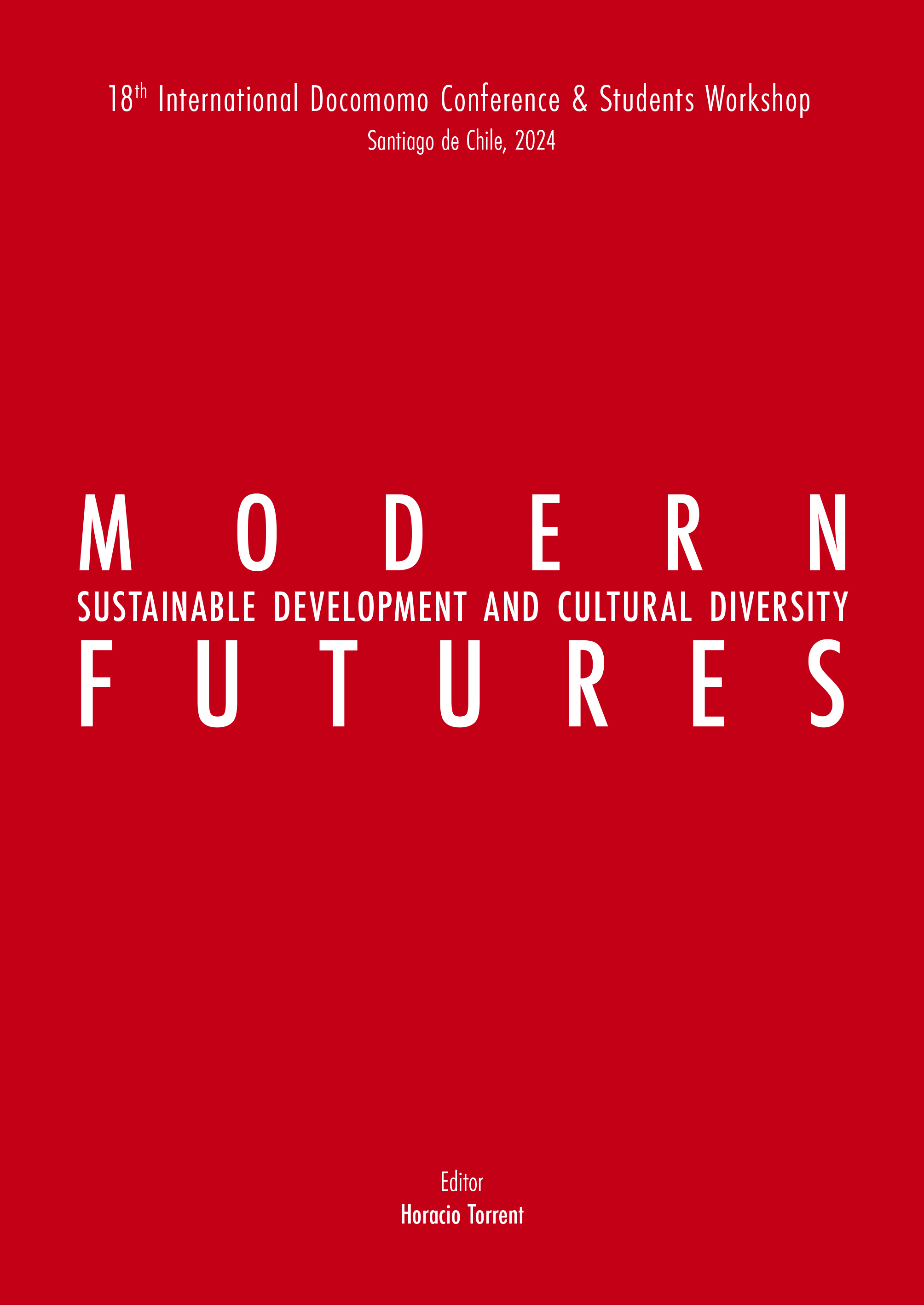
Modern Futures: Sustainable Development and Cultural Diversity
Libre acceso / Open AccessHoracio Torrent (ed.)
Tapa dura / Hardcover
17 x 24 cm | 1.648 pp.
Inglés / English
ISBN: 978-956-6204-22-0
Diciembre 2024
This volume gathers over 200 scholarly papers presented at the 18th International Docomomo Conference in Santiago de Chile. Serving as a global forum, the conference delves into the enduring legacy of the Modern Movement through the critical lenses of sustainability, cultural diversity, and heritage conservation. From its inception, modern architecture was not monolithic; it was a movement that flourished across continents, adapting to diverse climates, cultures, and urban contexts. As we face an increasingly urbanized world, the need to reimagine and adapt the spaces shaped by the Modern Movement is more urgent than ever.
Spanning a wide range of topics —from education, theory, and curatorial practices to prefabrication, circular economies, and feminist perspectives— these essays critically engage with the architectural, social, and ecological dimensions of our shared heritage. As we look to the past to inform a sustainable future, this collection challenges us to rethink conservation not just as preservation but as a transformative practice that acknowledges both global imperatives and local specificities. This book is an invaluable resource for architects, scholars, and practitioners dedicated to exploring how the diverse legacies of modern architecture can inform more inclusive and sustainable urban futures.
Ver más →
Ediciones ARQ - tienda
El Comendador 1936, oficina 101, Escuela de Arquitectura UC, Providencia, Santiago de Chile
Horario: Lun-Jue 10:00 a 17:30, Vie 10:00 a 15:30 hrs (excepto festivos)
tienda online︎︎︎
+56 22 3545630 | editorial@edicionesarq.cl
El Comendador 1936, oficina 101, Escuela de Arquitectura UC, Providencia, Santiago de Chile
Horario: Lun-Jue 10:00 a 17:30, Vie 10:00 a 15:30 hrs (excepto festivos)
tienda online︎︎︎
+56 22 3545630 | editorial@edicionesarq.cl