
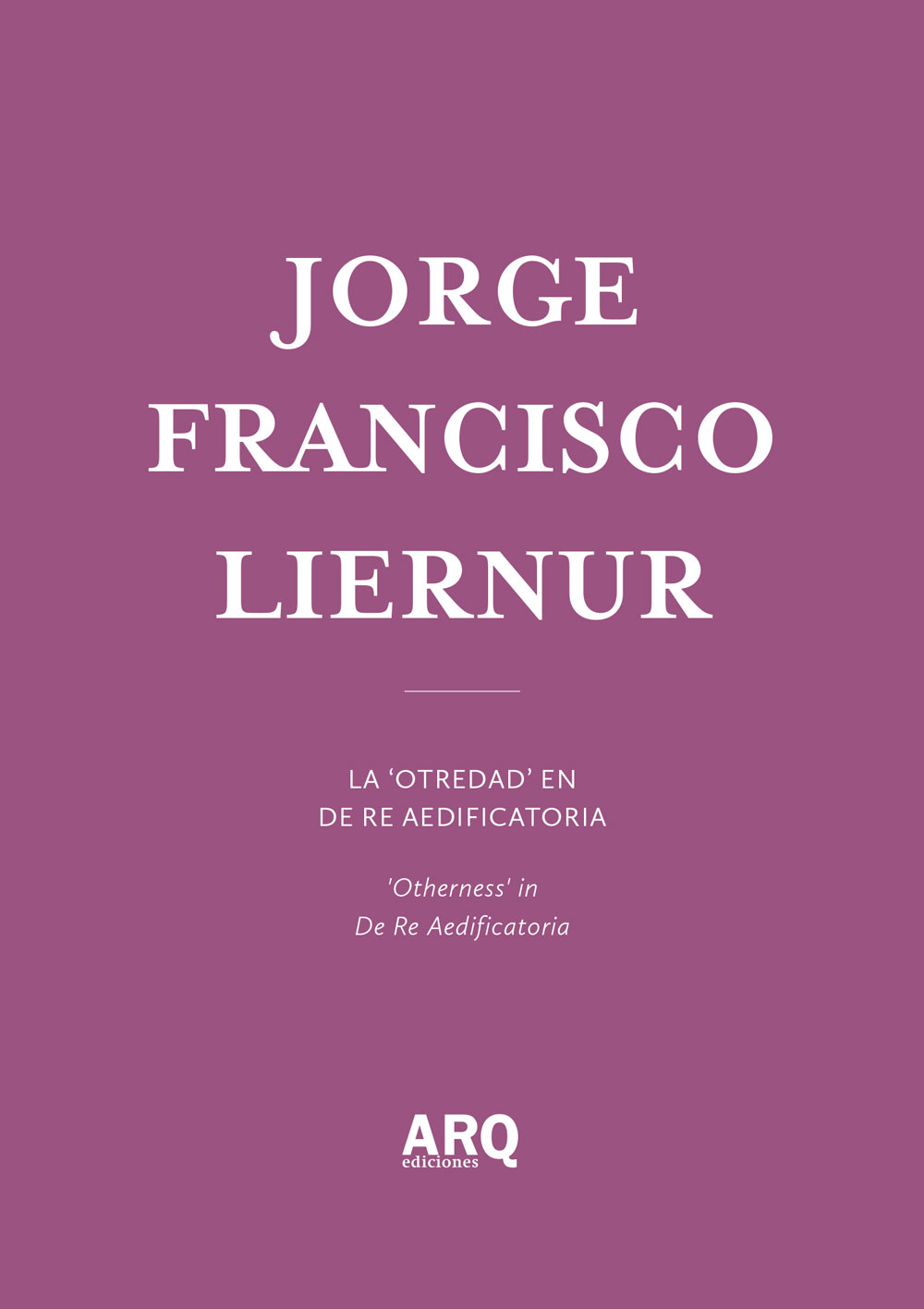
ARQ docs Jorge Francisco Liernur
Jorge Francisco Liernur; Francisco Díaz, Francisco Quintana (eds.)
Tapa blanda con sobrecubierta
12 x 17 cm | 128 pp.
Español + Inglés
ISBN: 978-956-9571-14-5
Junio 2016
Liernur siempre nos sorprende al realizar preguntas extemporáneas: ¿quién hubiese imaginado que De Re Aedificatoria [DRA] pudiera revelar algo sobre un tema clave de los estudios culturales de hoy como la ‘otredad’? Para responder a esto, el autor cruza tiempos muy diferentes: el pasado elegido por Alberti, con Vitruvio como su protagonista; el presente de Alberti, en las conflictivas décadas que conducen al ocaso de las ciudades libres; y también, en sordina, nuestro propio presente. La configuración de los tiempos resulta un tema clave para comprender a los ‘otros’ de Alberti.
Comprar
Leer en ARQ+
Tapa blanda con sobrecubierta
12 x 17 cm | 128 pp.
Español + Inglés
ISBN: 978-956-9571-14-5
Junio 2016
Liernur siempre nos sorprende al realizar preguntas extemporáneas: ¿quién hubiese imaginado que De Re Aedificatoria [DRA] pudiera revelar algo sobre un tema clave de los estudios culturales de hoy como la ‘otredad’? Para responder a esto, el autor cruza tiempos muy diferentes: el pasado elegido por Alberti, con Vitruvio como su protagonista; el presente de Alberti, en las conflictivas décadas que conducen al ocaso de las ciudades libres; y también, en sordina, nuestro propio presente. La configuración de los tiempos resulta un tema clave para comprender a los ‘otros’ de Alberti.
En el mundo humanista comienza a delinearse una concepción de la historia que, con matices, aún compartimos: la metodología crítica de lectura filológica que Valla puso a punto en su discurso sobre la donación de Constantino; la noción de que las culturas viven y mueren dejando trazos que apenas podemos entender (como los libros de Vitruvio). No fue hasta los tiempos de Alberti en que se asentó el relato de la ‘edad oscura’ que separaba drásticamente el viejo imperio occidental de la contemporaneidad (el término ‘medioevo’ se le atribuye a Flavio Biondo). En suma, la historiografía edifica desde entonces la técnica de distanciamiento con los pueblos del pasado. Si, tal como bellamente escribió L. P. Hartley, “the past is a foreign country”, no resulta forzada la afirmación de que Vitruvio es ‘un otro’ de Alberti, un extranjero.
Tal como Alberti, Liernur revisará al extranjero Vitruvio preguntándose quiénes eran ‘sus otros’, concluyendo que, en el mundo de la Pax Romana, los múltiples pueblos nombrados en los Diez Libros no son extraños sino más bien una parte indispensable de un complejo ‘nosotros’. [extracto prólogo de Graciela Silvestri]
En “¡Es el punto de vista, estúpido!”, Liernur sintetiza una de las propuestas que ha venido formulando en el último tiempo: estructurar un canon relativo, no centralista ni hegemónico, construido colectivamente, en un diálogo entre centro y periferia o, mejor dicho, trazado sobre una superficie geográfica y culturalmente continua en la que centro y periferia no existen o son fuertemente relativizados. Es a la idea de una difusión centrífuga, a la manera de las ondas concéntricas que provoca un proyectil sobre el agua, a la que Liernur se opone tenazmente. Su idea, en cambio, privilegia la cuestión del intercambio, de los reflejos entre espejos enfrentados, del diálogo interminable entre puntos que configuran una trama en continua mutación. Su ambición es que la historia de la arquitectura se inscriba con mayor comodidad dentro de una historia general de la cultura y de la historia a secas, nutriéndose y a la vez contribuyendo a una comprensión más rica y más profunda del acontecer contemporáneo. [extracto prólogo de Fernando Pérez]
Contenidos
Lado A — “La ‘otredad’ en De Re Aedificatoria”
Prólogo — Graciela Silvestri
Lado B — “¡Es el punto de vista, estúpido!”
Prólogo — Fernando Pérez Oyarzun
Ver más →
Jorge Francisco Liernur; Francisco Díaz, Francisco Quintana (eds.)
Softcover with dust jacket
12 x 17 cm | 128 pp.
English + Spanish
ISBN: 978-956-9571-14-5
June 2016
Liernur always surprises us by asking untimely questions: who would have imagined that De Re Aedificatoria [DRA] could reveal something about a key subject of today’s cultural studies such as ‘otherness’? To answer this, the author crosses very different times: the past chosen by Alberti, with Vitruvius as its protagonist; Alberti’s present, in the turbulent decades leading to the twilight of the free cities; and also, in muted form, our own present. The configuration of times proves a key theme for understanding Alberti’s ‘others.’
Buy
Read on ARQ+
Softcover with dust jacket
12 x 17 cm | 128 pp.
English + Spanish
ISBN: 978-956-9571-14-5
June 2016
Liernur always surprises us by asking untimely questions: who would have imagined that De Re Aedificatoria [DRA] could reveal something about a key subject of today’s cultural studies such as ‘otherness’? To answer this, the author crosses very different times: the past chosen by Alberti, with Vitruvius as its protagonist; Alberti’s present, in the turbulent decades leading to the twilight of the free cities; and also, in muted form, our own present. The configuration of times proves a key theme for understanding Alberti’s ‘others.’
In the humanist world a conception of history begins to take shape that, with nuances, we still share: the critical methodology of philological reading that Valla perfected in his discourse on the Donation of Constantine; the notion that cultures live and die leaving traces that we can barely understand (like Vitruvius’s books). It was not until Alberti’s time that the narrative of the ‘dark age’ was established, drastically separating the old Western empire from the contemporary world (the term ‘Middle Ages’ is attributed to Flavio Biondo). In short, historiography has since built the technique of distancing from the peoples of the past. If, as L. P. Hartley beautifully wrote, “the past is a foreign country,” it is no stretch to say that Vitruvius is ‘an other’ for Alberti, a foreigner.
Like Alberti, Liernur will revisit the foreigner Vitruvius by asking who ‘his others’ were, concluding that, in the world of the Pax Romana, the many peoples named in the Ten Books are not strangers but rather an indispensable part of a complex ‘us.’ [excerpt from the preface by Graciela Silvestri]
In “It’s the Viewpoint, Stupid!” Liernur summarizes one of the proposals he has been putting forward lately: to structure a relative canon, neither centralist nor hegemonic, built collectively, in a dialogue between center and periphery or, rather, drawn on a geographically and culturally continuous surface on which center and periphery do not exist or are strongly relativized. Liernur staunchly opposes the idea of a centrifugal diffusion, like the concentric ripples a projectile makes on water. His idea, by contrast, privileges exchange, the reflections between mirrors facing each other, the endless dialogue between points that make up a constantly mutating web. His ambition is for the history of architecture to sit more comfortably within a general history of culture and history plain and simple, drawing on and at the same time contributing to a richer and deeper understanding of contemporary events. [excerpt from the preface by Fernando Pérez]
Contents
Side A — “‘Otherness’ in De Re Aedificatoria”
Preface — Graciela Silvestri
Side B — “It’s the Viewpoint, Stupid!”
Preface — Fernando Pérez Oyarzun
Read more →
Ediciones ARQ - tienda
El Comendador 1936, oficina 101, Escuela de Arquitectura UC, Providencia, Santiago de Chile
Horario: Lun-Jue 10:00 a 17:30, Vie 10:00 a 15:30 hrs (excepto festivos)
tienda online︎︎︎
+56 22 3545630 | editorial@edicionesarq.cl